


Rikuzentakata
- Season Tse
- Nov 18, 2018
- 4 min read


I have chosen to come to Rikuzentakata for two reasons - to find the tallest, biggest seawall and to search for the international known Home-For-All installation by Toyo Ito. I hope to go with some fresh eyes so I didn’t do much research beforehand. I was guided by Aya-san from a local organisation Marugoto Rikuzentakata マルゴト陸前高田 who grew up in the town and came back after the tsunami to support the recovery of the town. She is a very friendly and knowledgeable lady, I was surprised when she spoke a few phases of Cantonese when we met.

Rikuzentakata is a rural area in Iwate Prefecture, north of Nobiru and Ishinomaki. The whole town was completely wiped out by 13m high waves. Nearly 8% of the population was lost, now population just less than 19,000. Before Before the earthquake, Rikuzentakata was known for the Takata Matsubara “Takata Pine Grove”, a two kilometer long stretch of shoreline covered by 70,000 pine trees. The beautiful tree-lined coast was ranked among the top 100 landscapes of Japan. After Unfortunately, the tsunami washed away all of the pine trees except one. This pine tree is called Miracle Pine, it eventually died after 18 months because of salt toxicity. The pine tree has been taken down, preserved and reinforced with steel. Now it has been reinstalled in the future location for the memorial park, the tree is very important to the local residents because it is a symbol of the people's resilience and hope. This preservation project was funded by the public.
The scale of reconstruction is even larger we have seen so far. However the recovery process in this town is slower compare to others because of a smaller population hence less funding. 12m metre tall seawalls are cladding the along the whole coast, mountain has been carved and soil was transported to raise this whole area by 10-12m from its original level, the government has planned to make the whole coast front a memorial park, they are at the moment planting new pine trees along the coast and will eventually start to transport sand from elsewhere to ‘restore’ the beach they once had. In terms of transportation, they are constructing a new highway connecting to Sendai, however, the JR train company has no intention and think it’s not worth to rebuild the railway in this area.

I think the topic about tsunami prevention infrastructure and seawall can easily be another talk because it is such a controversial topic. Many people, including myself, believe that building seawall is a knee-jerk reaction to the tsunami. In fact, seawall and wave breakers reduce the rate of destruction, compared to cases where no seawalls existed. They could potentially save many lives if the tsunami hits again. Also, the government said they have in-depth study and analyse the consequences to the sea habitat hence strategically located the seawalls. The long-term effect is still unknown. Some residents initially welcomed the idea of the walls but have become more critical over time, claiming they were not consulted enough in the planning stages or that the work has delayed rebuilding elsewhere, such as housing. Some criticise the existence of seawall could be detrimental because they offer a false sense of security, and prevent residents from being able to see the approaching danger first-hand. People who live in coastal area have been grown up with the sea since young age, and now seawall becomes a strong physical barrier between the land and the sea, in most places in town no one is able to see the sea anymore. I asked Katsu-san what he thought about the seawall, he said it was a difficult matter at the time because there was no time for the government to consult the local residents as well as it was very sensitive period, they had to do all they could to save the residents’ confidence.
Carving mountains also have such a huge impact on the habitat in the forest area. Not only lost of trees, many animals would have lost their homes. I saw a panicked fox confused and was running around in the abandoned school. The development has rapidly changed the landscape, not only animals are confused, people are confused as well in this new, artificial land.
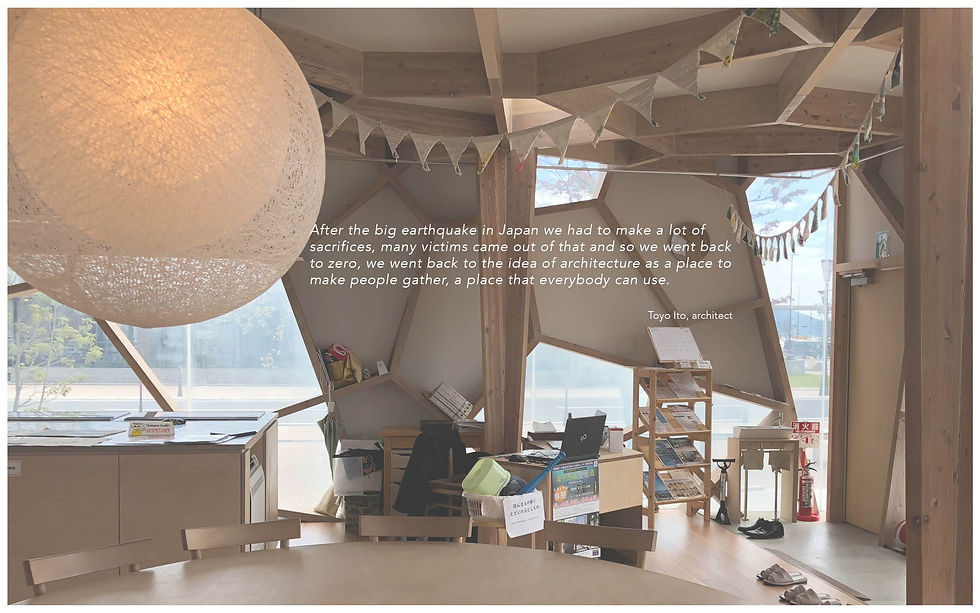
Minna no Ie - "Home-for-All" community houses are built in the areas of temporary housing and fishing harbors. where people could feel like at home, meet, relax and talk about the future of their city. The voluntary organisation is lead by Toyo Ito, Kazuyo Sejima, and Riken Yamamoto, they have been working closely with younger architects to help make a difference in the disaster area. Their intention is very simple, they think the idea of architecture should be back to its original intent, a place to make people gather, a place that everybody can use, rather than just economic vases. The work was displayed in the 13th Venice Biennale and was awarded the Golden Lion for Best National Participation, and Toyo Ito shared the prize with all the people affected by the tsunami. The project got a lot of international attention.
I was planned to see this Minna no ie however Aya-san told me that it was only a temporary installation and it has already been demolished, a new community house is on its way. She was very surprised how famous the Home for All became, she said the local community doesn’t even aware of that.
Of course I was very disappointed with the fact that I couldn’t visit the installation. Aya-san told me to another community hub which was designed by Toyo-Ito as well, adjacent to the new playground and shopping centre, its called the Honmaru no Ie. It was built somewhere else before and now relocated to this new site. It has become a community hub which locals can use or rent out for events. It is a very popular place for kids to read and rest after been playing in the playground.


Comments